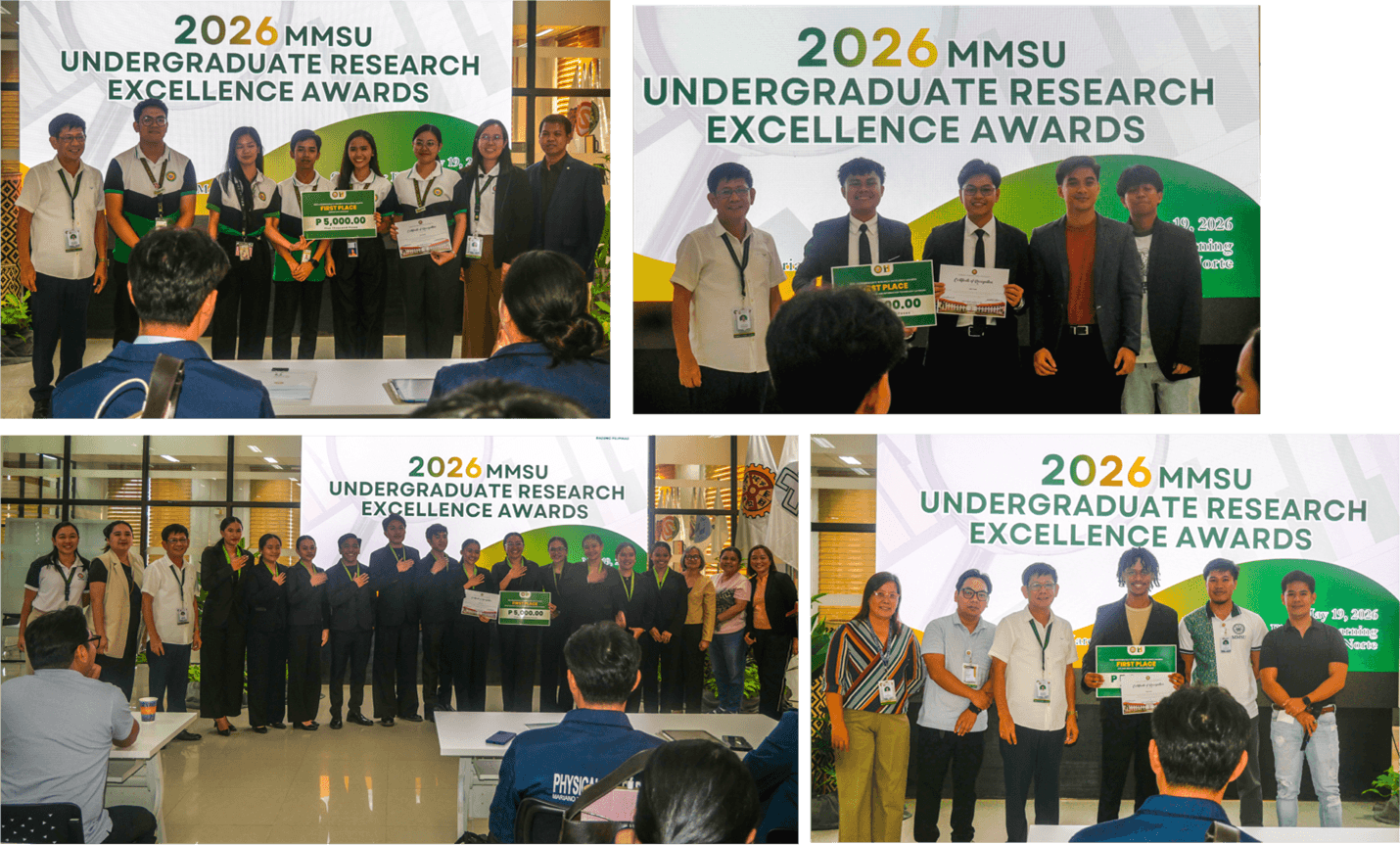
Mariano Marcos State University (MMSU), through its Research Directorate (RD), conducted the 2026 Undergraduate Research Excellence Awards (UREA) on May 19 at the Center for Flexible Learning, recognizing outstanding undergraduate research outputs across various academic disciplines.
The competition gathered student researchers from different colleges of the university who showcased their completed thesis projects in four categories: Education with seven entries; Life and Health Sciences with 10 entries; Physical Sciences, Engineering, and Information Technology with 12 entries; and Social Sciences, Humanities, Culture, and the Arts with 12 entries.
In his opening remarks, RD director Dr. Dionisio S. Bucao emphasized the importance of undergraduate research in addressing societal issues and fostering innovation. He noted that every research project requires months of preparation, data collection, revisions, and perseverance from both students and advisors.
Dr. Bucao said the program serves as a platform to recognize exemplary student research and inspire a stronger culture of inquiry, collaboration, and academic engagement among undergraduate learners. He added that the event also identifies outstanding theses that may represent the university in regional research competitions and possible publication in the university’s Science and Technology Journal.
Dr. Bucao said the program serves as a platform to recognize exemplary student research and inspire a stronger culture of inquiry, collaboration, and academic engagement among undergraduate learners. He added that the event also identifies outstanding theses that may represent the university in regional research competitions and possible publication in the university’s Science and Technology Journal.
Delivering the inspirational message on behalf of MMSU University President Dr. Virgilio Julius P. Manzano Jr., Vice President for Academic Affairs Dr. Aris Reynold T. Cajigal commended the RD for sustaining the activity and strengthening the research capabilities of students. He highlighted the role of research in preparing students not only to be professionals but also to be researchers, thinkers, and problem solvers.
In the Education category, the first-place award went to the study “Enhancing Grade 9 Students' Proficiency in Writing Conditional Sentences Through Colored Card Game: WhoKnows?” by Christine Kaye P. Dela Cruz, Trisha Ivy G. Dela Rosa, Ryan Joseph C. Dumbrique, Jeff C. Geralde, and Karyl G. Paz from the College of Teacher Education (CTE). The second-place award was given to “Ilokano Mothers’ Lived Experiences in Rearing Children for Early Childhood English Language Learning” by Maxene Janel C. Batangan of the College of Arts and Sciences (CAS). Third place went to “Enhancing Grade 7 Students' Mastery of Transitional Words in Writing Informative Essays Through ConnecTunes” by Matt Andrew J. Ancheta, Bea Kriz Q. Fernandez, Cedrick Jezrael L. Mateo, Jherly Helaena I. Valencia, and Joshua A. Villanueva from CTE.
For the Life and Health Sciences category, the first-place award was earned by “Mutations in Beta Globin (HBB) Gene Promoter and Effect in Transcription and Hematological Parameters” by Yousef Abdulrahman E. Lawal and Norman C. Garvida from CAS. Second place went to “In vitro and In vivo Antihyperglycemic Activity of Bamboo Shoot (Bambusa spinosa) Enriched with Lactobacillus hilgardii Cell Free Supernatant” by Rachel Anne M. Valera, Danica Jane S. Agni, Shamel Nikkie S. Luis, and John Carlo C. Quimoyog from the College of Health Sciences (CHS). Sharing the third place were “Influence of Lure Color on the Catch Efficiency, Sex Composition, and Gonado-Somatic Index (GSI) of Common Octopus (Octopus vulgaris) Using Simple Handline in Burgos, Ilocos Norte” by Yveth Yra C. Rafin and Philmark Laurenti O. Bumanglag from the College of Aquatic Sciences and Applied Technology (CASAT), and “Isolation and Identification of Putative Probiotic Bacteria from Onion (Allium cepa L.) Rhizosphere” by Trinity C. Meteoro from the College of Agriculture, Food and Sustainable Development (CAFSD).
In the Physical Sciences, Engineering, and Information Technology category, the top award was given to “Automated Measurement of Range of Motion and Detection of Joint Abnormalities in the Bilateral Upper Extremities Using Convolutional Neural Network” by Simon Zane S. Asis, Albert P. Castillo, Jayden Dale A. Geronimo, and Justin M. Viernes from the College of Engineering (COE). Second place was awarded to “Development of AI-Based Document Tracking and Management System” by Goldwynne Maeyr M. Villar, Precious Pia D. Yodico, and Althea Margharette Caranto Isagani V. Andres of the College of Computing and Information Sciences (CCIS). Third place went to “Notiface: Face Recognition-Based Parent Notification System” by Clarence A. Ballesteros, Shadrach Rover W. Bawingan, Rostum M. Borugsay, Altheia Marie S. Cruzado, Jerome P. Domingo, and Stanford Wendy A. Fernandez from the College of Industrial Technology (CIT).
Meanwhile, in the Social Sciences, Humanities, Culture, and Arts category, the first-place award was given to “Loom to Legacy: Assessing the Sustainability of Inabel Weaving in Pinili, Ilocos Norte Amid Generational Decline” by Jasmine E. Agoot, Queenie D. Andres, Learnelyn Aquino, Zairene F. Aquino, Maxeene Grace M. Buduan, Denmark Karl A. Cabaloan, Jewel Vin A. Dela Cruz, Tyrone A. Dela Rosa, Danica L. Manuel, Dyryn Jill D. Pagdilao, Adriana Earl Pascual, and Eden Grace A. Suguitan from the College of Business, Economics, and Accountancy (CBEA). Second place went to “The Effectiveness of Pandanggo Ilocano Dance in Improving Gait Speed and Balance among Elderly: A Quasi-Experimental Study” by Jea Mae B. Ancheta, Athaliah A. Calivoso, Glaiza Chrishel Q. Calventosa, Cris Mar H. Clemente, Gabrielle Jean T. Cristy, Carl Cedrick G. Flojo, and Jianne Claire M. Santos of the CHS. Third place was awarded to “Development of an Interactive Filipino Sign Language Learning Application” by Karla Denise A. Nalupta, Paul Andrew C. Pingkian, Marrione Lenard V. Flores, and Karl Zandro Pante from the CCIS.
The entries were evaluated by panels of experts composed of faculty members and specialists from other agencies.
The UREA is part of MMSU’s ongoing efforts to foster a vibrant student research culture and to promote innovative research that supports national development and community progress.