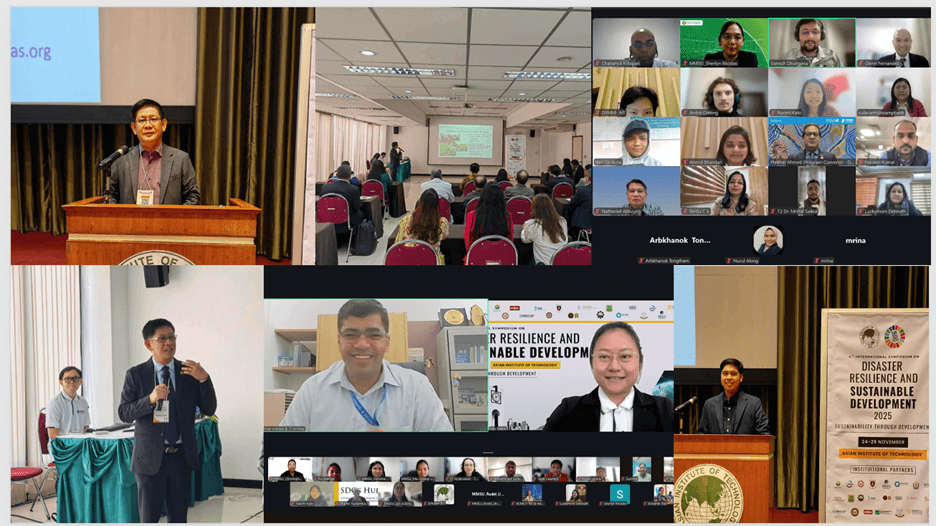
Mariano Marcos State University (MMSU) actively participated in the 4th International Symposium on Disaster Resilience and Sustainable Development (2025 DRSD) by presenting 13 research papers during the three-day international event held on November 24–26, 2025, at the Asian Institute of Technology (AIT) in Bangkok, Thailand.
The symposium was conducted in a hybrid format, allowing both on-site and online presentations via Zoom. Of the total MMSU papers, three were presented on-site at AIT, while ten were delivered online.
Presenting on-site at AIT were studies highlighting the roles of agriculture, health, and education in building resilient communities. Dr. Dionisio S. Bucao, MMSU Research director, presented the paper “Building resilient agricultural systems in climate-vulnerable areas of Ilocos Norte through science and technology-based community farm models.” Graduate School dean Dr. Doreen D. Domingo presented their study on “Alcohol-induced kidney damage: A hidden public health risk linking disaster preparedness and sustainable development,” while Dr. Mark Joseph Pastor shared “Schools as resilience anchors: Educational leadership for sustainable development and disaster risk governance.”
The university’s online participation featured 11 additional research papers presented by MMSU researchers. Engr. Ma. Gloann Leizel P. Longboy presented a study assessing coastal flood risks through tidal-integrated modeling: a case of the Padsan River Basin in Ilocos Norte, while Engr. Christine B. Mata examined the underestimated influence of tides and flood-control infrastructure during compound flooding events.
Community-centered and livelihood-focused studies were also highlighted. Ms. Lea C. Agbigay discussed the study, “Empowering coastal communities through documenting salt-making practices: Strengthening socioeconomic resilience and industry sustainability in the Philippines." Complementing this, Dr. Sherlyn Nicolas presented a community-based evaluation of crystallization pond flooring aimed at revitalizing salt farming as a sustainable livelihood, while Engr. Joemel Agreda shared a geospatial framework to identify climate-suitable saltern areas in Region I, supporting resilient and sustainable salt production.
Several studies addressed climate-responsive infrastructure, water management, and nature-based solutions. Dr. Rodel Utrera assessed the resilience of coastal flood protection structures in Region I: its implications for climate-responsive infrastructure planning, while Engr. Jade Calumpit presented laboratory-based insights on optimizing seawall designs to improve infrastructure resilience by analyzing wave overtopping, run-up, and rundown. Likewise, Dr. Arlene Gonzales, MMSU Director of Sustainability and Futures Thinking, discussed the technology-assisted mangrove restoration for coastal resilience in the Philippines. In the field of hydrology and climate data, Engr. Christopher T. Zamuco evaluated the suitability of GSMaP satellite-based precipitation data for runoff estimation in the Abra River Basin, providing valuable insights for flood forecasting and water resource planning. Meanwhile, Vice President for Research, Development, and Innovation Dr. Nathaniel R. Alibuyog delivered a hydrologic assessment of nature-based and climate-responsive water management strategies in the Abra River Basin under changing climate scenarios, emphasizing adaptive solutions for long-term resilience.
Educational and institutional dimensions of sustainability were likewise tackled with the presentation of Dr. Mee Jay Domingo, Vice President for Planning and Strategic Foresight, on the development and validation of an SDG knowledge assessment instrument for higher education institutions, contributing to the measurement of sustainability literacy in academe.
Aside from research presentations, MMSU also contributed to the symposium as one of the institutional partners. Dr. Bucao served as co-chair of the on-site technical session on “Interdisciplinary approaches for disaster risk reduction and sustainable development,” while Dr. Gonzales served as one of the panelists of the plenary discussion on “Delta and coastal socio-ecological systems: Climate threats, risk drivers
and resilience pathways.”
Organized by AIT in collaboration with institutional partners, the DRSD provides a platform for researchers, scholars, educators, policymakers, and development practitioners to exchange knowledge and interdisciplinary strategies for disaster risk reduction and sustainable development.