Photo Credits: https://www.facebook.com/dost.stii, MBVivit
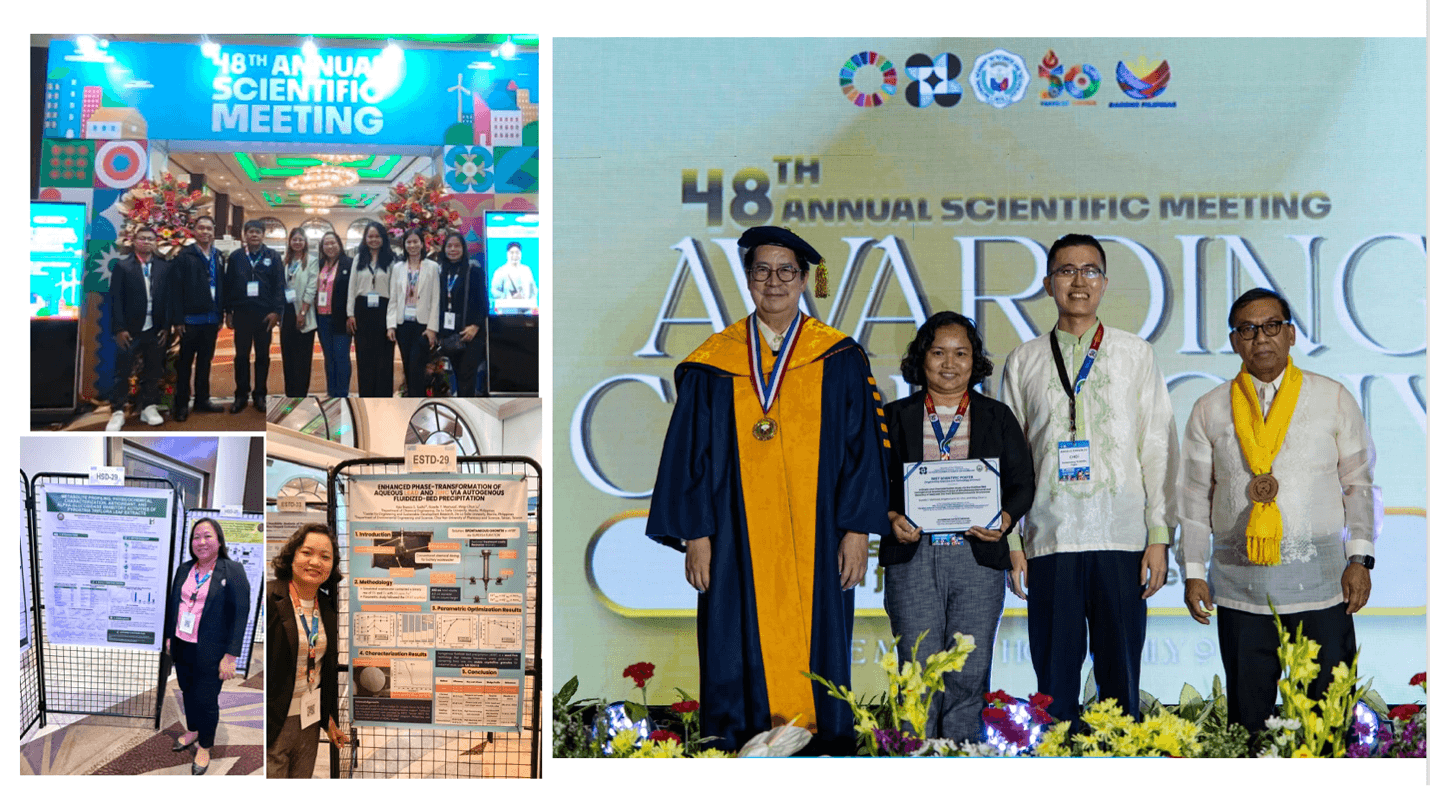
Faculty and full-time researchers from Mariano Marcos State University (MMSU) presented 16 scientific posters showcasing research results at the 48th Annual Scientific Meeting (ASM) of the National Academy of Science and Technology, Philippines (NAST PHL), with one MMSU entry winning the Best Scientific Poster Award in the Engineering category.
The annual event held on July 8-9, 2026, at the Manila Hotel featured 322 poster papers from universities and other institutions across the country, categorized into various thematic areas. It carried the theme "UN SDGs: Science, Technology, and Innovation for Sustainable Development."
Faculty and full-time researchers from Mariano Marcos State University (MMSU) presented 16 scientific posters showcasing research results at the 48th Annual Scientific Meeting (ASM) of the National Academy of Science and Technology, Philippines (NAST PHL), with one MMSU entry winning the Best Scientific Poster Award in the Engineering category.
The annual event held on July 8-9, 2026, at the Manila Hotel featured 322 poster papers from universities and other institutions across the country, categorized into various thematic areas. It carried the theme "UN SDGs: Science, Technology, and Innovation for Sustainable Development."
Dr. Roselle Y. Mamuad, a College of Engineering faculty, received the award for her poster titled "A kinetic and characterization study via the fluidized bed homogeneous granulation process of simultaneous removal and recovery of lead and zinc from simulated industrial wastewater."
MMSU’s poster presentations covered agriculture and food security, climate resilience, environmental science, health and biotechnology, engineering, materials development, and community livelihood—reflecting the University’s broad research contribution to sustainable development.
In agriculture and food security, Evangeline S. Galacgac presented “Performance of different varieties of garlic (Allium sativum) under Regions 1, 2, and CAR, Philippines weather conditions,” while Constante B. Julian shared “Varietal evaluation of corn for enhanced food security in the Ilocos.” Hazel G. Obien presented “Production management of tissue-cultured Kluai Namwa banana (Musa spp.) under nursery and field conditions.” Two studies focused on garlic health and production: Jonathan R. Ramos presented “Reduced incidence of purple blotch and cercospora feaf spot in garlic through relay cropping and spatial crop management,” while Milen Fileza M. Inocencio presented “Evaluation of the antioxidant activities and bioactive compounds of Ilocos Norte black garlic.”
Rodel T. Utrera presented four studies addressing environmental monitoring, water management, salt production, and coastal protection. These were “UV-NIR spectroscopy for species-level mangrove discrimination in Pasuquin, Ilocos Norte, Philippines”; “Climate-responsive water management strategies in the Philippines: A case study of the Abra River basin”; “Designing a climate-resilient and sustainable saltern prototype for small-scale salt production in the Philippines”; and “Laboratory investigation of wave-structure interactions for existing and geometrically modified seawalls: Overtopping, run-up, and rundown analysis.”
In health, pharmaceutical science, and biotechnology, Maingelline B. Vivit presented “Metabolite profiling, physicochemical characterization, antioxidant, and alpha-glucosidase inhibitory activities of Pyrostria trifloral feaf extracts.” Kristian Gay D. Beltran contributed two posters: “Anti-Inflammatory activity and toxicity profile of ethanolic extracts from three indigenous plants of Ilocos Norte” and “In vitro anticarcinogenic activity and probiotic viability of a synbiotic functional lozenge.” James Paul T. Madigal presented “Screening and fermentation performance of nipa sap-derived yeast strains for efficient bioethanol starter culture development.”
MMSU also showcased research studies in engineering and materials science. Together with Mamuad, Emie Mirasol also presented her poster “Single-source valorization of rice hull char into sodium silicate solution, structured silica, and activated carbon materials for diversified applications.”
Completing the MMSU entries, John Paul Agcaoili presented “From nipa palm innovation to sustainable community livelihood: An NBERIC initiative,” highlighting how research-driven innovation can be translated into livelihood opportunities and community development.
The University’s participation in the 48th NAST PHL ASM and its recognition in the Engineering Division underscore MMSU’s continuing commitment to producing relevant, multidisciplinary research. Through studies on food security, public health, climate resilience, environmental protection, industrial innovation, and sustainable livelihoods, MMSU researchers continue to advance science and technology solutions that address regional and national development needs.