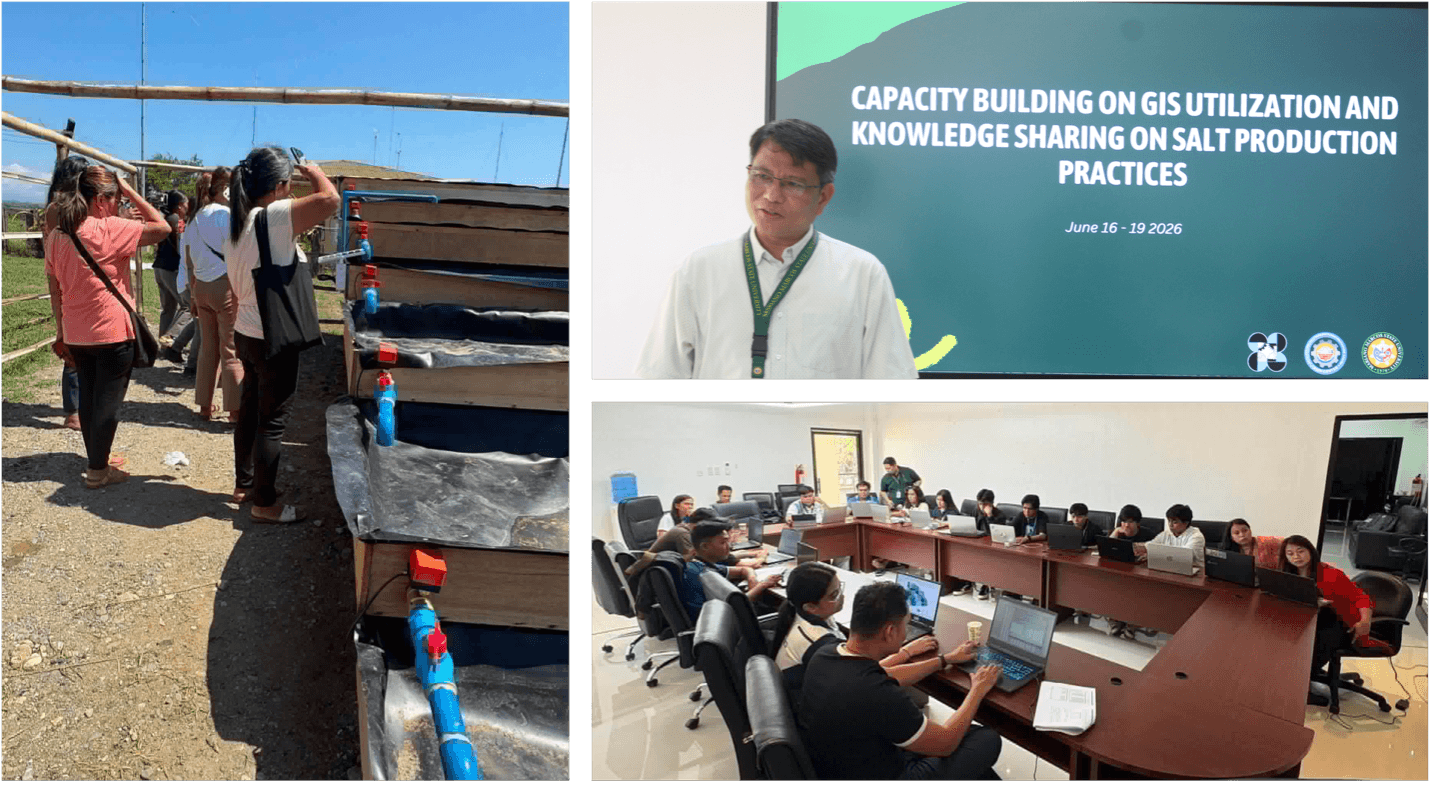
Mariano Marcos State (MMSU) University trained local government units and salt-making communities in GIS and science-based salt production practices during the three-day Capacity Building on GIS Utilization and Knowledge Sharing on Salt Production Practices program held on June 16-18, 2026, at the MMSU Coastal Engineering Research (CoastER) Center.
Conducted by the MMSU ASIN Project 1, the capacity-building activity aimed to strengthen local planning and decision-making through basic GIS training while sharing research-based salt production practices that can help improve productivity and support the revitalization of the local salt industry.
Participants included representatives from the provincial governments of Ilocos Norte, Ilocos Sur, Occidental Mindoro, and Pangasinan, as well as delegates from Laoag City and the municipalities of Paoay, Pasuquin, and Burgos. Also present during the event are representatives of partner agencies - the Department of Science and Technology, Region 1 One ASIN project, and the Bureau of Fisheries and Aquatic Resources.
Dr. Nathaniel R. Alibuyog, the MMSU VP for Research, Development, and Innovation and the ASIN Project Leader, underscored in his message during the opening program the project's role in improving local salt production through capacity building, technology transfer, and the promotion of best practices in saltern establishment and management. He also thanked the participants for their interest and commitment to supporting the salt industry by attending the event. He expressed optimism that the knowledge and skills acquired by participants would contribute to more sustainable, productive, and resilient salt-producing communities across the country.
The first two days focused on GIS utilization for local government participants. Sessions combined lectures and hands-on workshops on GIS concepts, suitability mapping, map preparation, spatial analysis, and data processing using QGIS. The training was designed to equip participants with practical tools for local planning, resource management, and evidence-based decision-making. The three-day workshop connected GIS-based planning with science-based salt production, providing public-sector participants and coastal communities with a common foundation for action.
Dr. Nathaniel R. Alibuyog, the MMSU VP for Research, Development, and Innovation and the ASIN Project Leader, underscored in his message during the opening program the project's role in improving local salt production through capacity building, technology transfer, and the promotion of best practices in saltern establishment and management. He also thanked the participants for their interest and commitment to supporting the salt industry by attending the event. He expressed optimism that the knowledge and skills acquired by participants would contribute to more sustainable, productive, and resilient salt-producing communities across the country.
The first two days focused on GIS utilization for local government participants. Sessions combined lectures and hands-on workshops on GIS concepts, suitability mapping, map preparation, spatial analysis, and data processing using QGIS. The training was designed to equip participants with practical tools for local planning, resource management, and evidence-based decision-making. The three-day workshop connected GIS-based planning with science-based salt production, providing public-sector participants and coastal communities with a common foundation for action.
For the salt-making sector, the workshop welcomed members of salt maker associations and communities from Pasuquin, Laoag City, Currimao, Paoay, and Badoc. Discussions covered the current status and challenges of the Philippine salt industry, the presentation of prototype saltern designs developed under ASIN Project 1, and the scientific and technical considerations for small- and large-scale salt farms.
Moreover, participants participated in hands-on demonstrations of small-scale salt production, enabling them to observe practical applications of the technologies and best practices discussed. This segment aimed to help local salt producers link scientific advice with their daily production experiences.
The training is part of the ongoing efforts of the ASIN Project 1, which promotes collaboration among academic institutions, government agencies, and local communities to develop a more sustainable and competitive salt industry in the Philippines.